
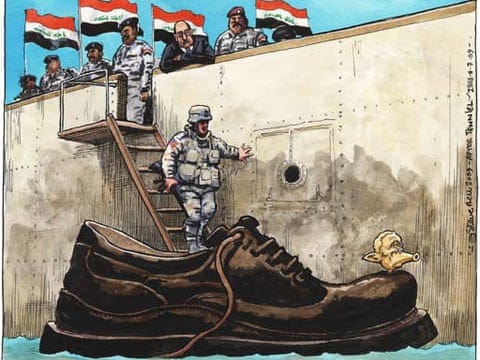
The clock is ticking. In just a few days, the final US military presence in Iraq will come to an end. For Washington, it marks the end of a long, bloody, and deeply controversial chapter. For Baghdad, political elites are eager to hail it as the ultimate test of national sovereignty. But beneath the celebratory speeches lies a terrifying reality: Iraq is being left dangerously exposed, and the fallout could tear the country apart all over again.
To understand the real danger, you have to look past the victory laps in Baghdad and look toward Erbil, the capital of the Kurdistan Region. The Kurds are not celebrating this departure. For them, American troops and air defence systems were never an imperial luxury; they were a essential shield against total chaos. With vital military hardware packing up, Erbil is staring down a vast security vacuum.
The fear in Kurdistan isn't political posturing; it is rooted in deep historical trauma. The Kurds bear the scars of genocide, mass graves, forced displacement, and chemical attacks under Saddam Hussein. When Kurdish leaders demand security guarantees today, they aren't trying to undermine Iraqi sovereignty - they are fighting for survival. They know that a federal state cannot function when one of its primary communities is forced to fear what comes tomorrow.
The immediate threat comes from the dozens of state-funded, heavily armed militias operating in Iraq outside Baghdad’s effective control. These groups, many aligned with regional powers like Iran, remain completely un-disarmed. Kurdish political leaders have already faced ugly political conspiracies aimed at marginalising the KRG espicially the Kurdistan Democratic Party - KDP and eroding Kurdistan’s constitutional rights. With US forces gone, many fear these rogue factions will feel emboldened to press harder against Erbil, destabilising the Kurdistan region entirely.
At the same time, the threat of an ISIS resurgence is far from dead. The terrorist group no longer holds vast swathes of land, but its sleeper cells continue to haunt the desert hideouts and disputed border zones between Iraqi army positions and Kurdish Peshmerga lines. That "no man's land" has historically been a breeding ground for terror. Without American intelligence, surveillance, and air power to bridge the gap, ISIS militants will find immediate room to breathe, rearm, and strike.
If sectarian violence breaks out or the country slips toward civil war, anyone expecting Washington to march back in to save the day will be sorely disappointed. The political appetite in the West for Middle Eastern combat missions is completely exhausted. While Washington may brandish the threat of economic sanctions if Baghdad fails to rein in lawless militias, a full-scale military re-intervention is effectively off the table. If Iraq catches fire, its people will largely be left to burn through it alone.
The wider regional picture is equally grim. America’s departure hands a massive strategic victory to Iran, solidifying a continuous corridor of influence running straight from Tehran to the Mediterranean. Meanwhile, Turkey will almost certainly ramp up its own military incursions into Kurdistan region to fight so called remnant of PKK fighters, further destabilising an already fragile region.
The tragedy of modern Iraq is that its crisis was never really about Kurdistan. The country is crippled by a breakdown of basic trust, a proliferation of uncontrolled weapons, dysfunctional state institutions, and unresolved land disputes. Yet time and again, political commentators and Baghdad politicians turn Erbil into a convenient scapegoat for every national failure, treating Kurdistan’s constitutional existence as if it were the root cause of the state's failure.
True sovereignty is not just about watching foreign soldiers pack their bags and leave. Real sovereignty means a government that commands its own security, reins in rogue militias, honors its own constitution, and makes every single citizen feel protected. Kurdistan is a red line - not because its government is above criticism, but because the existence, safety, and rights of its people are not bargaining chips.
The question we should be asking isn't why Erbil is terrified of tomorrow. The real question is why, after two decades and billions of dollars spent, Iraq remains a country where nobody truly feels safe. Until Baghdad addresses that failure, writing off Kurdistan as the problem won't save Iraq from what comes next.
The withdrawal day has finally arrived. Very concerning for the safety and security of the KRG. Also troubling to think this will embolden the most pro-Qom of the Hashd groups.
Agreed